.jpg)
Choosing the Right Hearing Aid
Independent Hearing Aid Advice for Resident of Brisbane, Ipswich & Logan
Choosing the right hearing aid is not about picking the “best brand” however it is about matching sound processing to how you hear and live.
The right hearing aid depends on:
• your hearing pattern
• your daily environments
• your listening effort
• your dexterity and confidence with technology
At Brighter Ears we compare hearing aid technologies across manufacturers and select what your brain understands most naturally not what is newest or most advertised.
Our choice and recommendation improves comfort, speech clarity and long-term success.

Why People Choose the Wrong Hearing Aid
Many disappointing hearing aid experiences happen because the selection focused on size or brand instead of hearing function.
Common mistakes:
• choosing the smallest hearing aid available
• copying a friend’s device
• selecting based on price only
• upgrading technology instead of correcting the actual fit of the aids
• not considering lifestyle listening environments
A hearing aid that is technically advanced can still perform poorly if it does not match the ear and hearing loss.
Steps Involved in Choosing the Right Hearing Aid
Step 1 — Match the Hearing Aid to Your Hearing Loss
Different hearing losses require different acoustic delivery.
For example:
High-frequency hearing loss (most common)
→ Often performs best with Receiver-in-Canal (RIC)
Severe to Profound hearing loss
→ May require Behind-the-Ear (BTE) power device
Mild loss
→ May suit small in-ear styles
The goal is not invisibility — it is speech understanding.
Step 2 — Match the Hearing Aid to Your Lifestyle
Technology level mainly affects performance in complex environments, not basic loudness.
-
Quiet lifestyle
(home conversation, TV, small groups)
→ comfort & natural sound quality matter most
-
Social lifestyle
(restaurants, gatherings, meetings)
→ noise suppression/speech separation and directionality matter most
-
Active lifestyle
(outdoors, community, movement)
→ automatic environment detection matters most
Higher technology improves ability to change aids setting, alter comfort in different situations, noise suppression — but not everyday volume.
Step 3 — Match the Hearing Aid to Dexterity & Confidence
Often overlooked but critical.
We assess:
• vision
• finger strength
• memory
• confidence with technology
• charging ability
A technically perfect hearing aid that is difficult to handle will not be worn consistently.
Technology Philosophy — Natural Sound vs Speech Clarity
Modern hearing aids don’t all process sound the same way. Different manufacturers tune amplification differently depending on how the brain interprets sound.
Some devices prioritise natural sound quality
→ softer, smoother listening experience
→ comfortable all-day wear
→ better tolerance for first-time users
Others prioritise speech clarity in noise
→ stronger speech contrast
→ improved conversation in groups
→ better performance in busy environments
→ reducing wind noise
There is also the balance between volume and clarity.
Good hearing is not simply louder hearing. A correct fitting adjusts:
• speech frequencies (clarity of words)
• bass sounds (fullness and comfort)
• treble sounds (sharpness and detail)
Too much bass → muffled sound
Too much treble → harsh or sharp sound
Too much volume → fatigue
Too little gain → limited or no benefit
The goal is recognisable speech at a comfortable listening level.
Different people tolerate sound differently, which is why two patients with the same audiogram may prefer completely different hearing aid processing.
This is where independent hearing aid comparison matters, we match the sound profile to how your brain accepts sound, not just the hearing test result.
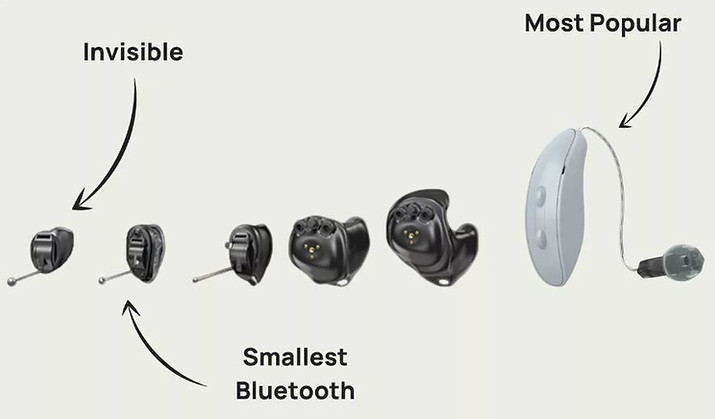
Different hearing aid styles are designed for different hearing patterns, not just appearance. Choosing the smallest hearing aid first often leads to poor outcomes. The correct approach is matching microphone position, power and acoustic performance to the hearing loss.
We commonly fit:
-
Receiver-in-Canal (RIC) hearing aids
Most versatile style. Good speech clarity and comfort for mild to severe hearing loss.
-
Behind-the-Ear (BTE) hearing aids
Higher power and durability. Better for dexterity concerns, moisture, and long-term reliability.
-
In-the-Ear (ITE) hearing aids
Easier handling and stable fit. Often suitable when insertion is difficult.
-
Invisible (CIC / IIC) hearing aids
Very discreet but limited microphone directionality and noise performance.
See full comparison on our Types of Hearing Aids page.

Smaller hearing aids sit deeper in the ear and may:
• reduce directional microphone benefit
• increase occlusion sensation
• limit power or noise reduction
• make adjustments harder
In noisy environments, microphone placement matters more than invisibility.
Hearing Aid Brands — Why Independence Matters
We fit and compare multiple hearing aid manufacturers:
• Starkey • Widex • Bernafon • Signia • Oticon • Phonak • Unitron • Resound
Each brand uses a different sound processing philosophy. There is no universally “best hearing aid brand”.
-
Some prioritise comfort
-
Some prioritise speech separation
-
Some prioritise environmental awareness
The correct choice depends on how your brain tolerates sound, not advertised claims.
This is why independent hearing aid clinics like Brighter Ears provide better matching, we select the device based on your listening goals.
Hearing Aid Trial — Try Before You Decide
Choosing hearing aids should never feel like a permanent commitment on the first visit.
At Brighter Ears, we provide a 2-week obligation-free hearing aid trial so you can experience the devices in your real daily environments — at home, at work, TV, shopping centres and social settings.
This allows you to answer the most important question: Does this hearing aid work for me, not just in the clinic?
During the trial you can:
• test speech clarity in real conversations
• compare comfort over full-day wear
• see how you cope in background noise
• decide if the style suits handling and insertion
• involve family feedback before committing
Many people are unsure about hearing aids because they fear choosing the wrong device. A proper trial removes pressure and gives you control over the decision.
We adjust the settings during the trial so the sound improves as your brain adapts.
There is no obligation to proceed, and we will advise if hearing aids are not yet necessary.
Local Hearing Aid Advice In Brisbane
We provide independent hearing aid selection and trials across:
Brisbane:
• Sumner
• Jindalee
• Inala
Ipswich
• Booval
• Brassall
• Goodna
• Redbank Plains
Logan
• Underwood
• Springwood
• Kingston
We provide ongoing local follow-up care rather than remote fitting services.
FAQ's
Which hearing aid brand is best?
The best hearing aid brand depends on how your brain processes sound, not marketing features. Different people perform better with different manufacturers.
Should I choose the smallest hearing aid?
Smaller hearing aids are more discreet but may perform worse in noise depending on hearing loss.
Do expensive hearing aids work better?
Only if they match your listening environments. Correct prescription matters more than price.
Can I try hearing aids before buying?
Yes — a proper hearing aid trial allows real-world testing before committing.
How do I know which hearing aid I need?
A diagnostic hearing test and lifestyle discussion determines the correct style and technology level.